AI Text Summarization: Complete Guide (2026)
Artificial intelligence has changed the way people consume information. In 2026, users are overwhelmed by long-form content, research papers, reports, blogs, emails, PDFs, and business documents. Attention spans are shrinking while the amount of digital information continues to grow exponentially. This is exactly why AI text summarization has become one of the most important productivity technologies in modern digital workflows.
From students and researchers to marketers, journalists, executives, and legal professionals, AI-powered summarization tools are now helping millions of users extract key insights from lengthy content within seconds.
This complete guide explains everything you need to know about AI text summarization in 2026, including how it works, its benefits, real-world use cases, different summarization techniques, limitations, and why AI summarization tools are becoming essential for businesses and individuals alike.
What Is AI Text Summarization?
AI text summarization is the process of using artificial intelligence and natural language processing (NLP) to condense long pieces of content into shorter, meaningful summaries while preserving the core message.
Instead of manually reading thousands of words, users can instantly generate concise summaries that highlight the most important information.
AI summarization tools can process:
- Articles
- Research papers
- PDFs
- Blog posts
- Meeting notes
- Emails
- Reports
- Academic journals
- Books
- News content
Modern AI summarizers use advanced machine learning models to understand context, sentence relationships, and semantic meaning rather than simply shortening text mechanically.
In 2026, AI summarization is no longer just a convenience feature. It has become a critical productivity layer across education, media, healthcare, finance, marketing, and enterprise operations.
Why AI Text Summarization Matters in 2026
The internet generates enormous volumes of information every single day. Businesses produce reports, researchers publish papers, and media outlets create continuous streams of articles.
The challenge is not finding information anymore. The real challenge is processing information efficiently. AI text summarization solves this problem by reducing reading time while helping users focus on key insights.
Some major reasons why AI summarization matters today include:
1. Information Overload
Professionals often deal with hundreds of pages of documents every week. AI summarizers reduce cognitive overload by highlighting essential information quickly.
2. Productivity Enhancement
Instead of spending hours reading, users can review summaries in minutes and make faster decisions.
3. Faster Research
Researchers and students can evaluate academic papers much more efficiently.
4. Content Consumption
Users increasingly prefer digestible content formats. AI summaries improve readability and engagement.
5. Enterprise Efficiency
Organizations use AI summarization to analyze reports, contracts, customer feedback, and internal communication at scale.
Transform long content into instant insights withTextSummarizer.io – summarize articles, PDFs, reports, and research papers in seconds using advanced AI.
How AI Text Summarization Works
AI text summarization relies heavily on natural language processing, deep learning, and transformer-based language models.
The process typically includes the following stages:
Step 1: Text Analysis
The AI system scans the input content and identifies:
- Keywords
- Sentence structures
- Topic relevance
- Semantic relationships
- Contextual meaning
Step 2: Importance Detection
The model determines which parts of the content carry the most informational value.
This may involve:
- Frequency analysis
- Entity recognition
- Topic modeling
- Attention mechanisms
Step 3: Summary Generation
The AI produces a condensed version while attempting to preserve:
- Context
- Meaning
- Readability
- Coherence
Advanced models can now generate highly natural summaries that resemble human writing.
Also Read: What is AI Text Summarization and How It Works
Types of AI Text Summarization
There are two primary types of AI summarization.
Extractive Summarization
Extractive summarization selects important sentences directly from the original content. The AI identifies key sentences and combines them into a summary without changing the wording.
Advantages
- Fast
- Accurate to source material
- Lower hallucination risk
Limitations
- Can sound robotic
- May lack smooth flow
Abstractive Summarization
Abstractive summarization generates entirely new sentences that capture the meaning of the original content. This approach is more similar to how humans summarize information.
Advantages
- More natural
- Better readability
- More concise
Limitations
- Higher computational complexity
- Potential factual inaccuracies
In 2026, many advanced AI tools combine both approaches for better results.
Key Benefits of AI Text Summarization
AI summarization tools offer major advantages across industries.
1. Saves Time
Users can summarize thousands of words within seconds. This is especially valuable for:
- Researchers
- Journalists
- Students
- Analysts
- Executives
2. Improves Productivity
Teams can process information faster and focus on strategic work instead of manual reading.
3. Enhances Learning
Students can understand complex materials more efficiently through concise summaries.
4. Simplifies Research
Academic professionals can quickly evaluate whether papers are relevant to their work.
5. Better Decision Making
Executives and managers can review summarized reports and insights faster.
6. Scalable Content Processing
Businesses can summarize massive datasets, customer reviews, support tickets, and documents automatically.
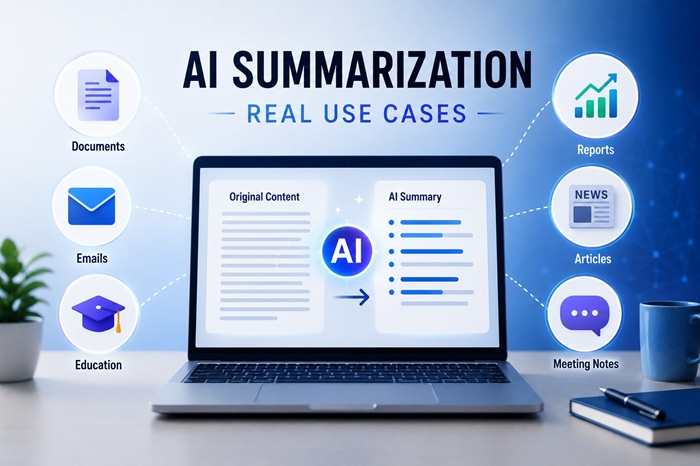
Real-World Use Cases of AI Summarization
AI summarization has rapidly expanded into real-world applications.
Education
Students use summarization tools to:
- Condense textbooks
- Simplify notes
- Summarize lectures
- Review study materials
Research & Academia
Researchers summarize:
- Academic papers
- Literature reviews
- Journals
- Scientific reports
Business & Enterprise
Companies summarize:
- Meeting transcripts
- Reports
- Emails
- Internal documentation
- Customer feedback
Media & Journalism
Journalists use AI tools to:
- Analyze lengthy reports
- Summarize breaking news
- Generate article highlights
Legal Industry
Legal professionals summarize:
- Contracts
- Case files
- Legal briefs
- Compliance documents
Healthcare
Healthcare organizations summarize:
- Patient records
- Clinical notes
- Research studies
- Medical reports
AI Text Summarization vs Manual Summarization
Traditional manual summarization requires:
- Reading full documents
- Identifying key points
- Rewriting summaries manually
This process is time-consuming and difficult to scale. AI summarization dramatically accelerates the workflow.
| Feature | Manual | AI Summarization |
| Speed | Slow | Instant |
| Scalability | Limited | High |
| Cost Efficiency | Lower | Higher |
| Human Effort | Significant | Minimal |
| Consistency | Variable | Consistent |
However, human oversight is still important for highly sensitive or technical content.
Limitations of AI Text Summarization
Although AI summarization has improved significantly, it still has certain limitations.
1. Context Loss
Some AI tools may omit nuanced details.
2. Hallucinations
Advanced generative models may occasionally introduce inaccurate information.
3. Technical Content Challenges
Highly specialized documents may require domain expertise.
4. Tone Preservation
Some summaries may fail to maintain the original writing tone.
5. Data Privacy Concerns
Businesses handling confidential information should carefully evaluate data security practices. Despite these limitations, AI summarization continues to improve rapidly due to advances in large language models and NLP research.
Best Features to Look for in an AI Summarizer
When choosing an AI summarization tool in 2026, users should evaluate several important features.
Accuracy
The summary should preserve the original meaning.
Speed
Fast processing improves productivity.
Adjustable Summary Length
Users should be able to choose concise or detailed summaries.
Multilingual Support
Global users increasingly require multilingual summarization.
Ease of Use
Simple interfaces improve adoption and usability.
AI Quality
Modern transformer-based models generally produce better contextual summaries.
Future of AI Text Summarization
The future of AI summarization is extremely promising. Several emerging trends are expected to shape the industry beyond 2026.
Personalized Summaries
AI systems will increasingly adapt summaries based on user preferences and reading behavior.
Real-Time Summarization
Live summarization for meetings, webinars, and conferences will become more advanced.
Multimodal Summarization
Future systems will summarize:
- Videos
- Audio
- Images
- Documents
within a unified workflow.
Enterprise AI Integration
Businesses will integrate summarization deeply into CRM, productivity, and analytics platforms.
Higher Accuracy
Next-generation AI models will continue reducing hallucinations and improving contextual understanding.
AI summarization is expected to become one of the foundational technologies powering productivity in the AI-first economy.
How TextSummarizer.io Helps WordPress Users Save Time
For WordPress publishers, bloggers, editors, and content teams, managing large volumes of content efficiently has become increasingly challenging in 2026.
TextSummarizer.io helps WordPress users simplify content workflows with AI-powered text summarization directly designed for modern publishing needs.
The platform enables users to:
- Instantly summarize long blog posts
- Generate concise article overviews
- Improve content readability
- Create quick previews for readers
- Simplify research-heavy content
- Reduce manual editing time
- Enhance user engagement with digestible summaries
For websites publishing high volumes of content, AI summarization can significantly improve workflow efficiency while helping readers consume information faster.
As content consumption habits continue evolving, WordPress-focused AI summarization tools are becoming an essential part of modern publishing and content optimization strategies.
Final Thoughts
AI text summarization has evolved from a basic productivity feature into a critical digital intelligence tool. In 2026, the ability to process and understand information quickly is becoming one of the most valuable skills for businesses and individuals.
AI summarization tools are helping users save time, improve efficiency, accelerate research, and consume information more effectively than ever before.
As artificial intelligence continues advancing, summarization technology will become even more accurate, personalized, and deeply integrated into everyday workflows.
For anyone dealing with large amounts of content, AI text summarization is no longer optional. It is becoming essential.