Extractive vs Abstractive Summarization: What’s the Difference?
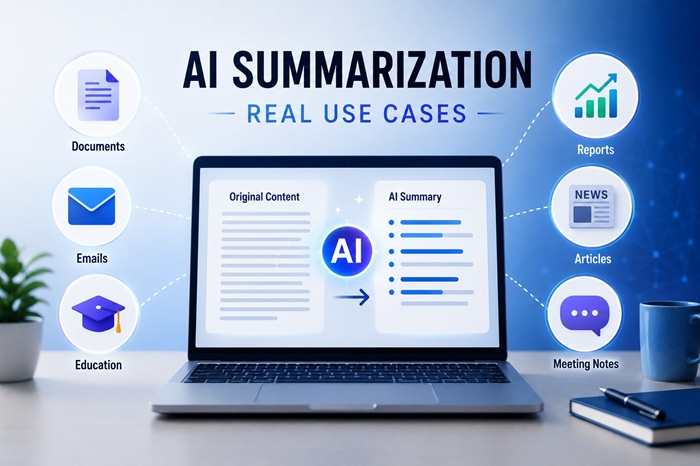
Artificial intelligence has transformed how people process information online. From research papers and business reports to blog articles and meeting transcripts, AI summarization tools are helping users consume large volumes of content faster than ever before.
But not all AI summarization methods work the same way.
In modern natural language processing (NLP), there are two primary approaches to AI text summarization:
- Extractive summarization
- Abstractive summarization
Understanding the difference between these two methods is essential for businesses, publishers, researchers, students, and content creators looking to choose the right AI summarization workflow.
This guide explains how extractive and abstractive summarization work, their advantages, limitations, real-world applications, and which approach performs better in different scenarios.
What Is AI Text Summarization?
AI text summarization is the process of using artificial intelligence and natural language processing to condense long-form content into shorter, meaningful summaries while preserving the core message.
Modern AI summarization systems can process:
- Articles
- PDFs
- Reports
- Research papers
- Emails
- Legal documents
- Academic journals
- Business content
To better understand the foundations of AI summarization, readers can explore AI Text Summarization: Complete Guide (2026).
In 2026, most advanced summarization systems rely on either extractive methods, abstractive methods, or a hybrid combination of both.
What Is Extractive Summarization?
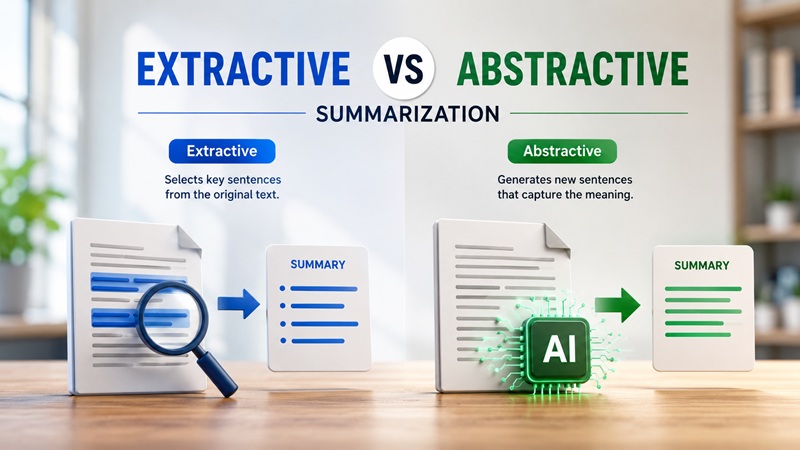
Extractive summarization works by selecting the most important sentences directly from the original content and combining them into a shorter summary.
Instead of generating new text, the AI identifies high-value sentences based on importance and relevance. The wording remains unchanged because the summary uses original sentences from the source material.
How Extractive Summarization Works
Extractive summarization systems analyze content using techniques such as:
- Keyword frequency
- Sentence ranking
- Topic relevance
- Entity recognition
- Statistical importance
- Attention mechanisms
The AI identifies which sentences contain the highest informational value and assembles them into a condensed version.
For users exploring what is AI text summarization and how it works, extractive summarization is often considered the foundational approach to AI summarization.
Advantages of Extractive Summarization
1. Higher Factual Accuracy
Because extractive summaries use exact sentences from the source material, the risk of hallucinations is significantly lower.
This makes extractive summarization useful for:
- Legal content
- Financial reports
- Technical documentation
- Research material
2. Faster Processing
Extractive methods generally require less computational complexity compared to abstractive models. This allows faster summarization workflows.
3. Better Source Alignment
Since the wording remains unchanged, summaries stay closely aligned with the original document. This improves reliability for sensitive information.
Limitations of Extractive Summarization
1. Robotic Flow
Extracted sentences may not connect naturally. The summary can sometimes feel fragmented or disjointed.
2. Redundant Information
Multiple selected sentences may repeat similar ideas. This can reduce summarization efficiency.
3. Limited Compression
Extractive summaries often remain longer because they rely entirely on existing sentences. They cannot rewrite information more concisely.
What Is Abstractive Summarization?
Abstractive summarization generates entirely new sentences that capture the meaning of the original content. Instead of copying sentences directly, the AI interprets the information and rewrites it in a shorter form.
This approach is closer to how humans summarize content. Modern transformer-based AI models have significantly improved abstractive summarization capabilities in recent years.
How Abstractive Summarization Works
Abstractive AI systems use deep learning and large language models to:
- Understand semantic meaning
- Interpret contextual relationships
- Rewrite information naturally
- Generate concise summaries
These systems rely heavily on transformer architectures and advanced NLP techniques.
Modern AI summarizers increasingly use hybrid workflows that combine extractive and abstractive approaches for improved results.
Advantages of Abstractive Summarization
1. More Natural Readability
Abstractive summaries typically sound more fluent and human-like. This improves readability and user experience.
2. Better Compression
The AI can rewrite ideas more efficiently, creating shorter summaries without relying entirely on original sentences.
3. Improved Content Flow
Generated summaries usually maintain smoother transitions between ideas. This creates better coherence.
Limitations of Abstractive Summarization
1. Hallucination Risk
Abstractive AI models may occasionally generate inaccurate information that was not present in the source content. This remains one of the biggest challenges in generative AI summarization.
2. Higher Computational Requirements
Generating new text requires more processing power and advanced AI infrastructure.
3. Potential Context Loss
Some nuanced details may be simplified or omitted during summary generation. This can slightly alter the original meaning.
Extractive vs Abstractive Summarization: Key Differences
| Feature | Extractive Summarization | Abstractive Summarization |
| Method | Selects original sentences | Generates new sentences |
| Readability | Moderate | High |
| Hallucination Risk | Lower | Higher |
| Compression Ability | Limited | Strong |
| Processing Complexity | Lower | Higher |
| Contextual Flexibility | Limited | Advanced |
| Human-Like Output | Lower | Higher |
| Factual Reliability | Strong | Moderate to Strong |
Which Summarization Method Is More Accurate?
In general, extractive summarization is considered more factually reliable because it uses original source sentences directly.
However, abstractive summarization often provides:
- Better readability
- More concise output
- Improved user experience
For users asking how accurate AI summarizers are, the answer often depends on whether the AI uses extractive, abstractive, or hybrid summarization models.
Modern AI summarization systems increasingly combine both methods to balance:
- Accuracy
- Readability
- Compression
- Context retention
Real-World Applications of Extractive Summarization
Extractive summarization is commonly used for:
Legal Documents
Preserving exact wording is important for legal accuracy.
Financial Reports
Maintaining factual consistency is critical.
Scientific Research
Research summaries often require direct alignment with original findings.
Enterprise Documentation
Businesses use extractive methods for internal knowledge management and structured reporting.
Real-World Applications of Abstractive Summarization
Abstractive summarization performs especially well for:
Blog Content
Readable summaries improve user engagement.
News Articles
Short, natural summaries help readers consume information quickly.
Marketing Content
Generated summaries often sound more polished and user-friendly.
Educational Material
Students benefit from simplified explanations and concise overviews.
Hybrid AI Summarization: The Future of Summarization Technology
In 2026, many advanced AI summarization systems now combine extractive and abstractive methods.
Hybrid models aim to achieve:
- Strong factual reliability
- Better readability
- Lower hallucination rates
- Improved contextual understanding
This hybrid approach is becoming increasingly important for enterprise AI workflows and modern content publishing.
How TextSummarizer.io Helps Users Simplify Long-Form Content
As AI summarization technology continues evolving, platforms like TextSummarizer.io help users process information faster with AI-powered summarization workflows designed for modern publishing and productivity needs.
The platform helps users:
- Summarize articles quickly
- Simplify research-heavy content
- Improve reading efficiency
- Generate concise summaries
- Reduce information overload
- Process long-form content faster
For publishers, bloggers, students, researchers, and professionals, AI summarization tools are becoming essential for managing growing volumes of digital information efficiently.
Users exploring the best WordPress AI summary plugin for blogs increasingly look for summarization systems that balance both accuracy and readability.
The Future of AI Summarization
AI summarization is rapidly evolving beyond basic text compression. Future summarization systems are expected to deliver:
Personalized Summaries
AI-generated summaries tailored to user behavior and reading preferences.
Multimodal Summarization
Future systems will summarize:
- Videos
- Audio
- Images
- Documents
- Meetings
within unified workflows.
Better Context Retention
Next-generation models will improve nuance preservation and factual consistency.
Lower Hallucination Rates
Advanced transformer architectures are expected to reduce generative inaccuracies significantly.
Simplify long-form content and improve reading efficiency withTextSummarizer.io – an AI summarization platform designed for speed, clarity, and productivity.
Final Thoughts
Both extractive and abstractive summarization play critical roles in modern AI workflows.
Extractive summarization provides stronger factual consistency and reliability, while abstractive summarization delivers more natural readability and better compression.
In 2026, the most advanced AI summarization systems increasingly combine both approaches to create summaries that are:
- Accurate
- Readable
- Context-aware
- Scalable
As AI continues advancing, summarization technology will become even more intelligent, personalized, and deeply integrated into digital productivity workflows.
For businesses, publishers, researchers, and content creators, understanding the difference between extractive and abstractive summarization is becoming increasingly important in the AI-first information economy.