Can AI Summarize Better Than Humans?
Artificial intelligence has transformed how people process information through modern AI text summarization technologies. From lengthy research papers and business reports to blog posts and news articles, AI-powered summarization tools can now condense thousands of words into concise summaries within seconds.
As AI technology continues advancing, a common question has emerged among businesses, publishers, researchers, and content creators:
Can AI summarize better than humans?
The answer is not as simple as yes or no.
Modern AI summarization systems have become remarkably effective at processing information quickly and accurately. However, human summarization still offers advantages in contextual understanding, critical thinking, emotional interpretation, and domain expertise.
This guide explores the strengths and limitations of both approaches, compares AI and human summarization across different use cases, and explains where each method performs best in 2026.
Understanding AI Text Summarization
Before comparing AI and human performance, it is important to understand how modern AI text summarization works.
Today’s AI systems use natural language processing, machine learning, and transformer-based language models to analyze content and identify the most important information.
Readers looking for a deeper overview can explore the complete guide to AI text summarization in 2026.
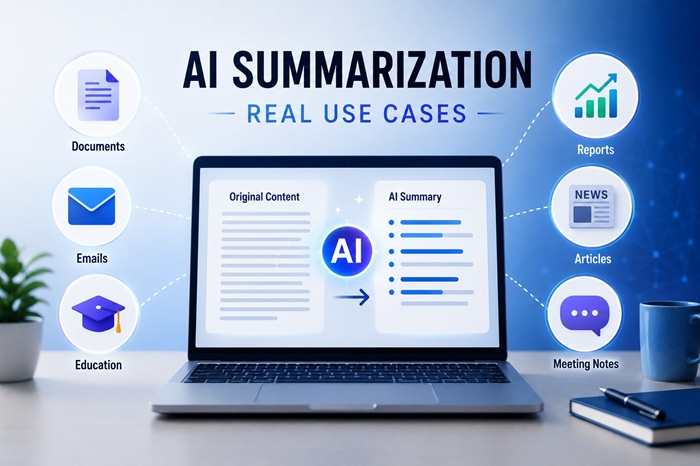
AI summarization tools are commonly used to process:
- Articles
- Research papers
- Reports
- PDFs
- Emails
- Meeting transcripts
- Blog content
- Business documents
The goal is simple: reduce reading time while preserving essential information.
How Humans Summarize Content
Human summarization relies on interpretation, reasoning, and contextual understanding.
When a person summarizes content, they often:
- Identify key ideas
- Evaluate relevance
- Understand nuance
- Interpret intent
- Recognize emotional context
- Adapt summaries for specific audiences
Unlike AI systems, humans can draw upon personal experience, industry knowledge, and critical thinking skills.
This often allows people to preserve subtle meanings that machines may overlook.
How AI Generates Summaries
Modern AI summarizers analyze content differently than humans.
Instead of relying on personal judgment, AI models evaluate:
- Keywords
- Topic relationships
- Semantic meaning
- Sentence importance
- Contextual patterns
Most modern tools use a combination of extractive and abstractive summarization techniques.
Those interested in understanding the difference can explore extractive vs abstractive summarization and how each method affects summary quality.
As language models continue improving, AI-generated summaries are becoming increasingly natural and readable.
Where AI Outperforms Humans
There are several areas where AI summarization clearly has an advantage.
Speed
Humans may require minutes or even hours to summarize long documents. AI systems can summarize thousands of words in seconds.
This makes AI especially valuable for organizations handling large amounts of information daily.
Need faster summaries without sacrificing clarity? Visit https://textsummarizer.io and generate concise summaries from articles, reports, blogs, and research documents within seconds.
Scalability
A human editor can only process a limited number of documents each day.
AI systems can process:
- Thousands of articles
- Customer feedback datasets
- Research papers
- Internal reports
- Meeting transcripts at a scale that would be impossible manually.
Consistency
Human summarization quality may vary depending on:
- Experience
- Fatigue
- Workload
- Subject familiarity
AI systems maintain consistent output across large volumes of content.
This consistency is one reason many organizations are adopting AI summarization for business professionals and enterprise workflows.
Productivity
AI dramatically reduces time spent reading and reviewing content.
Organizations increasingly use AI tools to:
- Accelerate research
- Improve knowledge management
- Simplify reporting
- Support content creation
This trend helps explain how AI text summarizers can revolutionize productivity across industries.
Where Humans Still Perform Better
Despite impressive advances, AI has not completely surpassed human summarization.
There are several areas where people still maintain a significant advantage.
Understanding Nuance
Humans are better at identifying:
- Implicit meaning
- Cultural references
- Humor
- Sarcasm
- Emotional tone
These subtle elements can be difficult for AI systems to interpret accurately.
Domain Expertise
Specialized industries often require deep knowledge.
Examples include:
- Law
- Medicine
- Scientific research
- Regulatory compliance
A legal expert reviewing a contract may notice details that an AI summarizer could overlook.
Strategic Interpretation
Humans excel at connecting information across multiple contexts.
For example, executives reviewing business reports often need:
- Strategic insights
- Risk assessment
- Market interpretation
- Decision-making support
This type of reasoning extends beyond simple summarization.
Is AI More Accurate Than Humans?
Accuracy depends heavily on the content being summarized.
For general content such as:
- Blog posts
- News articles
- Educational material
- Business documentation
Modern AI systems can often achieve excellent results.
Readers interested in this topic can explore how accurate AI summarizers are and the factors that influence summary quality.
For highly specialized or sensitive content, human review remains important. This is particularly true when factual precision is critical.
AI Summarization vs Manual Summarization
The debate is not necessarily about replacing humans.
Instead, many organizations now focus on combining both approaches.
A growing number of businesses use AI summarization vs manual summarization workflows that balance speed with human oversight.
The typical process looks like this:
- AI generates an initial summary.
- Humans review and refine the content.
- Final summaries combine efficiency with contextual accuracy.
This hybrid approach is becoming increasingly common in publishing, research, and enterprise environments.
AI and WordPress Publishing
Content publishers face growing pressure to produce more content while maintaining quality.
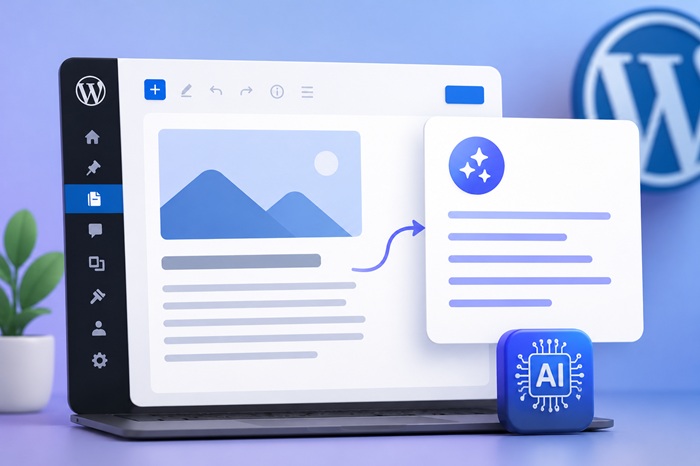
AI summarization helps WordPress teams:
- Reduce editorial workload
- Improve reader engagement
- Create article summaries
- Simplify long-form content
- Increase publishing efficiency
Many publishers now summarize WordPress blog posts in one click rather than creating summaries manually. As content production scales, AI-assisted publishing workflows continue becoming more valuable.
Can AI Replace Human Summarizers?
In most cases, AI should be viewed as an enhancement rather than a replacement.
AI excels at:
- Speed
- Scalability
- Consistency
- Automation
Humans excel at:
- Judgment
- Interpretation
- Creativity
- Expertise
- Contextual understanding
The most successful workflows combine both strengths.
Rather than replacing professionals, AI allows them to focus on higher-value tasks while automation handles repetitive work.
How TextSummarizer.io Helps Users Work Smarter
As information overload continues increasing, AI-powered tools are becoming essential for managing digital content efficiently.
TextSummarizer.io helps users:
- Summarize long-form content instantly
- Process articles faster
- Simplify research workflows
- Improve reading efficiency
- Reduce information overload
- Generate concise summaries in seconds
Whether you are a student, researcher, publisher, marketer, or business professional, AI summarization can significantly improve productivity.
For users evaluating solutions, choosing the best AI text summarizer tool often comes down to balancing speed, accuracy, and usability.
The Future of Human and AI Summarization
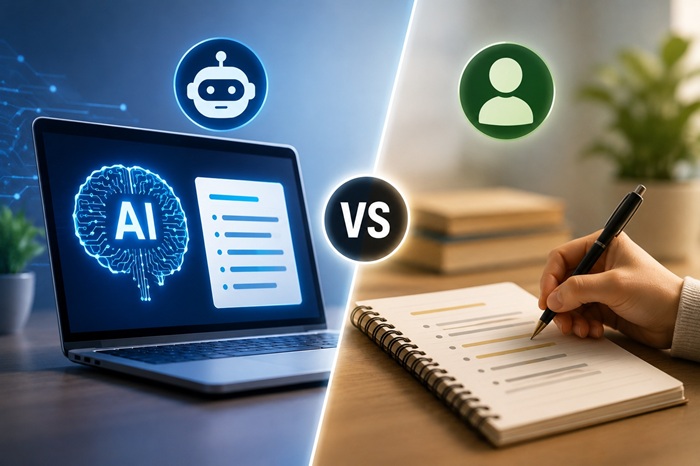
The future is unlikely to be AI versus humans. Instead, it will be AI plus humans.
Future summarization systems are expected to deliver:
- Better contextual understanding
- Lower hallucination rates
- Personalized summaries
- Multimodal summarization
- Real-time content processing
As these capabilities mature, AI will become an increasingly powerful partner for professionals working with large amounts of information.
Turn hours of reading into minutes. Use TextSummarizer.io to generate concise AI-powered summaries and streamline your content workflow.
Final Thoughts
Can AI summarize better than humans?
For speed, scalability, consistency, and productivity, AI often outperforms human summarization. For nuanced interpretation, strategic thinking, emotional understanding, and domain expertise, humans still hold important advantages.
In 2026, the most effective approach is not choosing one over the other.
It is combining both.
AI handles large-scale information processing, while humans provide judgment, context, and final validation. Together, they create a workflow that is faster, smarter, and more effective than either approach alone.